Model-based design uses physics-based models. It starts with prior knowledge and iterates through the loop until a satisfactory model is found. We have already discussed parameter estimation in the first part of the workshop. If we have multiple models, we can discriminate among them to find the best model that fits the data. However, that is not a part of this workhsop.
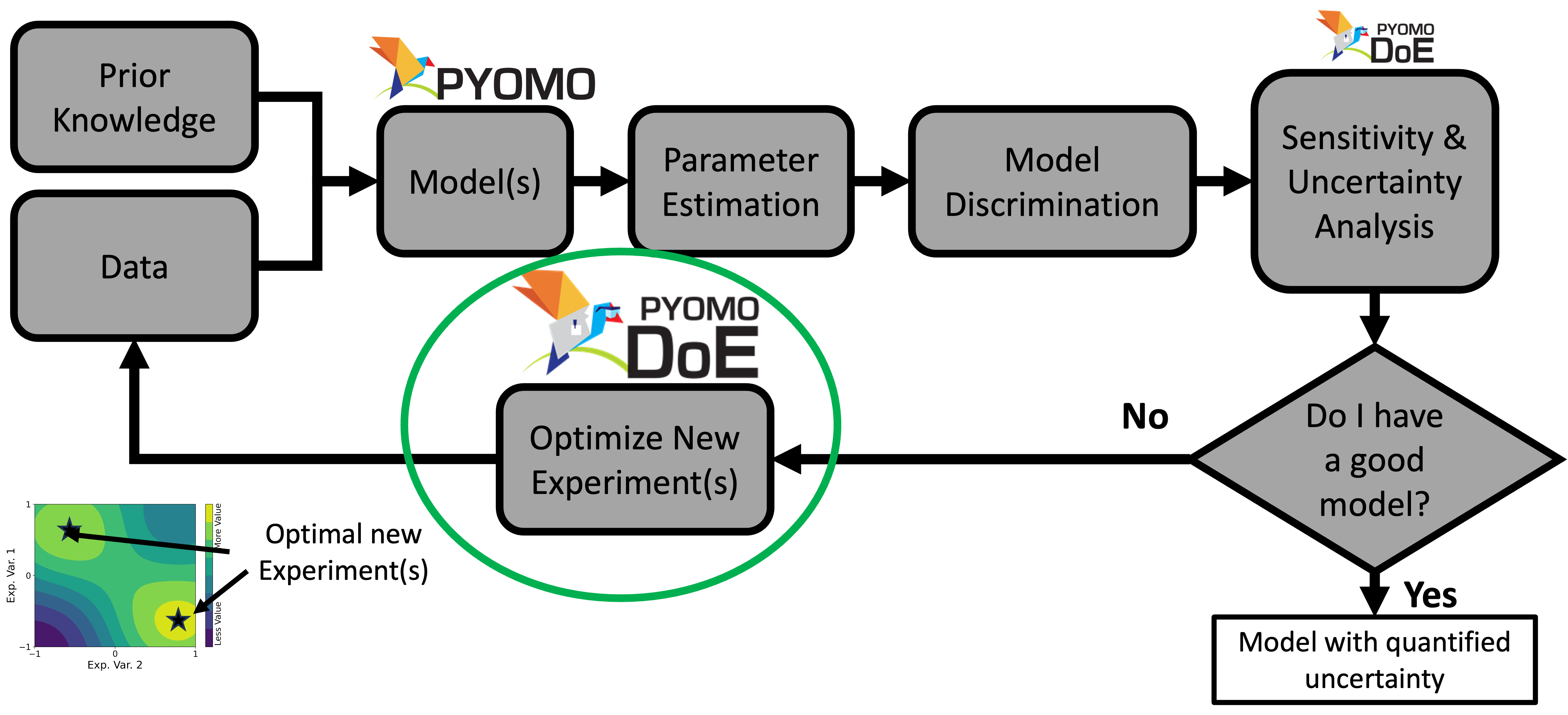
In the optimize new experiments step, we can design a single experiment (sequential design), or we can design multiple experiments (multi-experiment design). We will discuss both in this workshop.
Fisher Information Matrix
The covariance matrix () can be approximated as the inverse of the Fisher information matrix (). Mathematically,
For a normally distriuted measurement error, the Fisher information matrix (FIM) can be defined as
Where,
is the vector of model responses
is the measured responses
is the measurement error covariance matrix
is the vector of unknown parameters
is the vector of nominal values of the parameters
Scaling in Pyomo.DoE
Parameters and model responses with vastly different magnitudes (e.g., 10,000 vs 0.001) cause severe rounding errors and ill-conditioned Fisher Information Matrices (FIM). Pyomo.DoE provides two scaling strategies to address this:
1. Constant Scaling (scale_constant_value)
Multiplies every element of the sensitivity matrix by a single uniform scalar.
Impact: Shifts the overall magnitude to avoid floating-point errors, but does not improve the matrix condition number.
2. Nominal Parameter Scaling (scale_nominal_param_value)
Scales each column of the sensitivity matrix by its corresponding nominal parameter value, converting absolute sensitivities into relative ones:
Impact: Directly improves the condition number of the sensitivity matrix and the resulting FIM. This is the preferred choice when parameter ranges span multiple orders of magnitude.
Note: If we use scaling, then we also need to ensure that the prior FIM is also scaled accordingly and after designing the experiments, we also need to unscale the FIM to make a fair comparison.
Optimization Formulation
Maximize a scalar-valued function of the Fisher information matrix :
Here, is the prior Fisher information matrix, i.e., Fisher information matrix from prior experiments and the heater power is the design variable. Design variables are the experimental conditions which can be controlled during the experiment. The overall goal is to optimize a scalar metric of the Fisher information matrix by changing the design variable.
Pyomo.DoE automatically formulates, initializes, and solves this optimization problem. Here, we will start with the simplest objective defined as , i.e., pseudo-A-optimality. There are other many other optimality criteria. A-, D-, E, and ME-optimality will be discussed in the next notebook. In this section, we will see how to design an experiment using pseudo-A-optimality.
For documentation follow the Pyomo documentation page.
Optimal Experiment Design
In this section, we introduce the basic syntax for ODE with Pyomo.DoE.
Import Necessary Functions
# Import necessary packages and functions
import sys

# If running on Google Colab, install Pyomo and Ipopt via IDAES
on_colab = "google.colab" in sys.modules
if on_colab:
    !wget "https://raw.githubusercontent.com/dowlinglab/pyomo-doe/main/notebooks/tclab_pyomo.py"

# import TCLab model, simulation, and data analysis functions
from tclab_pyomo import (
    TC_Lab_data,
    TC_Lab_experiment,
    extract_results,
    extract_plot_results,
    results_summary,
)

# set default number of states in the TCLab model
number_tclab_states = 2
Load Experimental Data (sine test)
We load the sine-test experimental data to initialize the model. Our create_model function uses the supplied data to set initial values for the Pyomo variables. Careful initialization is often important when solving large-scale dynamic optimization problems.
import pandas as pd

if on_colab:
    file = "https://raw.githubusercontent.com/dowlinglab/pyomo-doe/main/data/tclab_sine_test_5min_period.csv"
else:
    file = "../data/tclab_sine_test_5min_period.csv"
df = pd.read_csv(file)
df[["Time", "T1", "Q1", "Q2"]].head()  # the Q2 column entries are 0 because
# we are considering the two-state model (Q1, T1)For completeness, we will visualize the data again.
ax = df.plot(x="Time", y=["T1"], xlabel="Time (s)", ylabel="Temperature (°C)")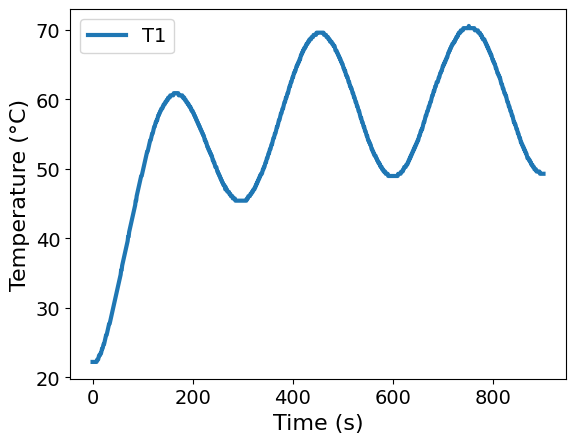
ax = df.plot(x="Time", y=["Q1", "Q2"], xlabel="Time (s)", ylabel="Heater Power (%)")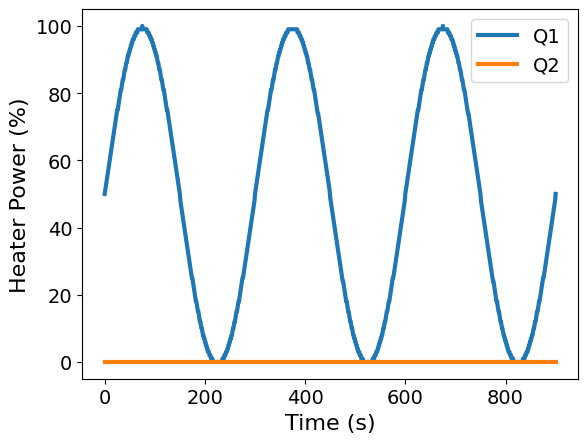
And then we will store the data in an instance of our TC_Lab_data dataclass to help us organize the data.
# Here, we will induce a step size of 6 seconds, as to not to make the problem too large,
# so that we can solve the problem in manageable time.
skip = 6

# Create the data object considering the new control points every 6 seconds
tc_data = TC_Lab_data(
    name="Sine Wave Test for Heater 1",
    time=df["Time"].values[::skip],
    T1=df["T1"].values[::skip],
    u1=df["Q1"].values[::skip],
    P1=200,
    TS1_data=None,
    T2=df["T2"].values[::skip],
    u2=df["Q2"].values[::skip],
    P2=200,
    TS2_data=None,
    Tamb=df["T1"].values[0],
)
Use Prior Parameter Information
As shown earlier, the model is not estimable in its original form, so we used regularization in the previous notebook. Here, we reuse the resulting parameter estimates and covariance matrix as prior information for experimental design.
import numpy as np

# Theta values estimated from the regularized regresssion in the previous notebook
# L2 regularization
theta_values = {
    "Ua": 0.041705,
    "Ub": 0.012009,
    "inv_CpH": 0.167457,
    "inv_CpS": 4.545432,
}

# L2 regularization (diagonal)
cov = np.array(
    [
        [1.857017e-10, -2.576198e-10, 1.402148e-09, -2.242347e-12],
        [-2.576198e-10, 1.624383e-07, 9.109870e-08, -6.325555e-05],
        [1.402148e-09, 9.109870e-08, 1.031454e-07, -3.890789e-05],
        [-2.242347e-12, -6.325555e-05, -3.890789e-05, 2.499914e-02],
    ]
)
PRIOR_FIM = np.linalg.inv(cov)

# Let's look at the FIM to see how informative our prior is before optimization
results_summary(PRIOR_FIM)
======Results Summary======
Five design criteria log10() value:
Pseudo A-optimality: 9.910298890895081
A-optimality: -1.6020703142934263
D-optimality: 27.781982236650098
E-optimality: 1.6020710987913134
Modified E-optimality: 8.254407420205586
FIM:
[[ 7.17766325e+09 1.00811757e+08 -2.18902252e+08 -8.56071665e+04]
[ 1.00811757e+08 8.99331580e+08 1.51888631e+08 2.51198161e+06]
[-2.18902252e+08 1.51888631e+08 5.68992000e+07 4.72881315e+05]
[-8.56071665e+04 2.51198161e+06 4.72881315e+05 7.13206905e+03]]
eigenvalues:
[7.18585615e+09 9.25285788e+08 2.27591861e+07 4.00010230e+01]
Eigenvector matrix:
eigvec_1 eigvec_2 eigvec_3 eigvec_4
Ua 0.9994 0.0098 0.0326 -0.0000
Ub 0.0153 -0.9846 -0.1743 -0.0025
inv_CpH -0.0304 -0.1747 0.9842 -0.0016
inv_CpS -0.0000 -0.0028 0.0011 1.0000
From the eigendecomposition, we see that we have the least confidence in inv_CpS and the highest confidence in Ua. We now design the next experiment to improve parameter precision.
Optimize Next Experiment (Pseudo-A-Optimality)
Next, we consider pseudo-A-optimality, which here is based on maximizing the trace of the Fisher information matrix.
from pyomo.contrib.doe.utils import rescale_FIM

theta_ref = np.array(
    [
        theta_values["Ua"],
        theta_values["Ub"],
        theta_values["inv_CpH"],
        theta_values["inv_CpS"],
    ]
)
# Because the parameter values differ substantially in magnitude, we can use parameter
# scaling in DesignOfExperiments to improve numerical conditioning.
SCALE_BY_NOMINAL_PARAM = True
SCALE_CONSTANT_VALUE = 1e-2
if SCALE_BY_NOMINAL_PARAM:
    PRIOR_FIM_SCALED = rescale_FIM(PRIOR_FIM, theta_ref) * SCALE_CONSTANT_VALUE**2
else:
    PRIOR_FIM_SCALED = PRIOR_FIM * SCALE_CONSTANT_VALUE**2
from pyomo.environ import SolverFactory
# Add a solver object to pass to DesignOfExperiments
solver = SolverFactory("ipopt")
solver.options["max_iter"] = 3000
solver.options["tol"] = 1e-6
solver.options["linear_solver"] = "ma57"
solver.options["nlp_scaling_method"] = "gradient-based"from pyomo.contrib.doe import DesignOfExperiments
# Create experiment object for design of experiments
doe_experiment = TC_Lab_experiment(
data=tc_data, theta_initial=theta_values, number_of_states=number_tclab_states
)
# Create the design of experiments object to initialize the FIM and the Jacobian,
# which we will then pass to the main design of experiments object for optimization.
TC_Lab_DoE_init = DesignOfExperiments(
experiment=doe_experiment,
step=1e-2,
scale_constant_value=SCALE_CONSTANT_VALUE,
scale_nominal_param_value=SCALE_BY_NOMINAL_PARAM,
prior_FIM=PRIOR_FIM_SCALED,
solver=solver,
tee=True,
)
try:
init_fim = TC_Lab_DoE_init.compute_FIM()
init_jac = TC_Lab_DoE_init.seq_jac
except:
init_fim = None
init_jac = None# Create the design of experiments object using our experiment instance from above
TC_Lab_DoE_pA = DesignOfExperiments(
experiment=doe_experiment,
step=1e-2,
scale_constant_value=SCALE_CONSTANT_VALUE,
scale_nominal_param_value=SCALE_BY_NOMINAL_PARAM,
objective_option="pseudo_trace",
# Now we specify a type of objective,pseudo-A-opt = "pseudo_trace"
prior_FIM=PRIOR_FIM_SCALED,
solver=solver,
tee=True,
jac_initial=init_jac,
fim_initial=init_fim,
)
TC_Lab_DoE_pA.run_doe()Now, let’s visualize the design that we get from the pseudo-A-optimaity.
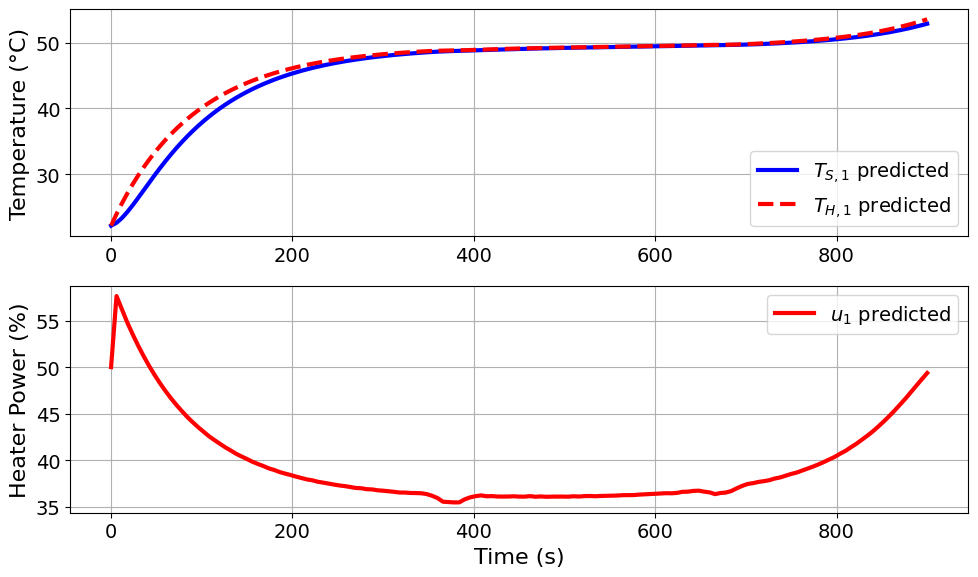
pAopt_pyomo_doe_results = extract_plot_results(
    None, TC_Lab_DoE_pA.model.fd_scenario_blocks[0]
)
Model parameters:
Ua = 0.0421 Watts/°C
Ub = 0.012 Watts/°C
CpH = 5.9717 Joules/°C
CpS = 0.22 Joules/°C
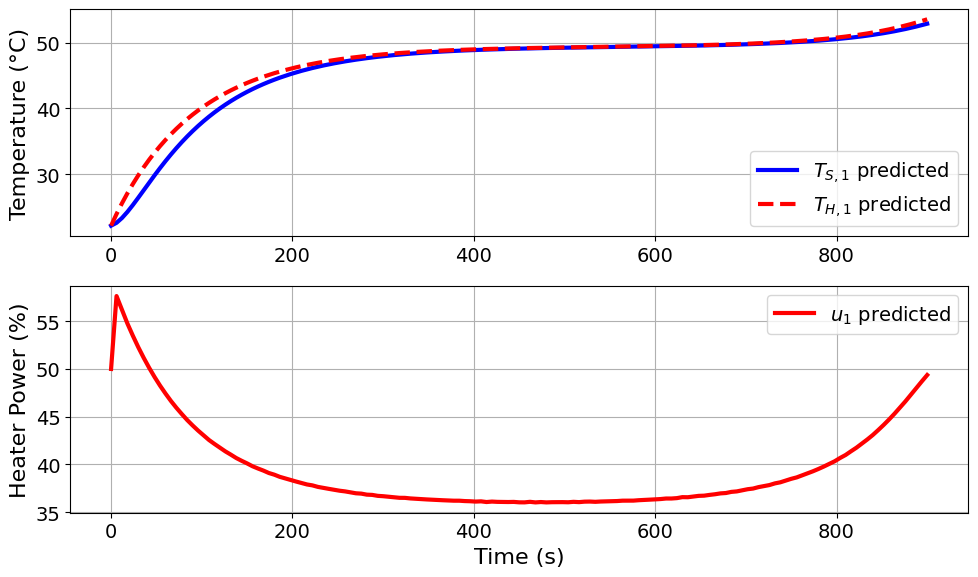
Interesting! The pseudo-A-optimal design pushes the heater power and then the heater power gradually decreases before rising again.
FIM_pA = np.asarray(TC_Lab_DoE_pA.results["FIM"])
if SCALE_BY_NOMINAL_PARAM:
    D = np.diag(theta_ref)
    FIM_unscaled = D @ FIM_pA @ D / SCALE_CONSTANT_VALUE**2
else:
    FIM_unscaled = FIM_pA / SCALE_CONSTANT_VALUE**2
results_summary(np.asarray(FIM_unscaled))
======Results Summary======
Five design criteria log10() value:
Pseudo A-optimality: 9.910302962865462
A-optimality: -4.85599662725043
D-optimality: 31.037359540806495
E-optimality: 4.857406506174441
Modified E-optimality: 4.99907213427213
FIM:
[[ 7.17766519e+09 1.00811750e+08 -2.18903352e+08 -8.93427504e+04]
[ 1.00811750e+08 8.99331580e+08 1.51888655e+08 2.51214462e+06]
[-2.18903352e+08 1.51888655e+08 5.69015067e+07 4.84151439e+05]
[-8.93427504e+04 2.51214462e+06 4.84151439e+05 7.91462314e+04]]
eigenvalues:
[7.18585816e+09 9.25285883e+08 2.27613731e+07 7.20122708e+04]
Eigenvector matrix:
eigvec_1 eigvec_2 eigvec_3 eigvec_4
Ua -0.9994 -0.0098 -0.0326 -0.0000
Ub -0.0153 0.9846 0.1743 -0.0024
inv_CpH 0.0304 0.1747 -0.9842 -0.0020
inv_CpS 0.0000 0.0028 -0.0016 1.0000
Compare the Reduction in Predicted Uncertainty
# Helper function to print parameter values with their standard deviations
def param_std(
    std: np.ndarray,
    parameters: dict = theta_values,
):
    for i, key in enumerate(parameters.keys()):
        print(f"{key}: {parameters[key]:.3e} ± {std[i]:.3e}")
# Now compare the uncertainty for the prior and the optimized design to see how much
# improvement we have achieved in terms of parameter uncertainty reduction.
cov_pA = np.linalg.inv(FIM_unscaled)
std_pA = np.sqrt(np.diag(cov_pA))
std_prior = np.sqrt(np.diag(cov))
print("Parameter estimates with standard deviations for the prior:")
param_std(std_prior)
print(
"\nParameter estimates with predicted standard deviations for the optimized design:"
)
param_std(std_pA)Parameter estimates with standard deviations for the prior:
Ua: 4.170e-02 ± 1.363e-05
Ub: 1.201e-02 ± 4.030e-04
inv_CpH: 1.675e-01 ± 3.212e-04
inv_CpS: 4.545e+00 ± 1.581e-01
Parameter estimates with predicted standard deviations for the optimized design:
Ua: 4.170e-02 ± 1.363e-05
Ub: 1.201e-02 ± 4.965e-05
inv_CpH: 1.675e-01 ± 2.065e-04
inv_CpS: 4.545e+00 ± 3.726e-03
In the last experiment, we used the sine data for initialization. We will change that in our exercise.
skip = 6

# Create the data object considering the new control points every 6 seconds
tc_data = TC_Lab_data(
    name="Sine Wave Test for Heater 1",
    time=df["Time"].values[::skip],
    T1=df["T1"].values[::skip],
    u1=df["Q1"].values[::skip],
    P1=200,
    TS1_data=None,
    T2=df["T2"].values[::skip],
    u2=df["Q2"].values[::skip],
    P2=200,
    TS2_data=None,
    Tamb=df["T1"].values[0],
)
from dataclasses import replace
# =========================== ACTIVITY ===============================
# ------------------- Choose a new design for u1 -------------------
# Set a random seed for reproducibility
SEED: int = 105 # Choose any integer seed you like
PDF = "normal" # Choose between "normal" or "uniform" distribution for the new design of u1
# ------------------------------------------------------------------
rng = np.random.default_rng(seed=SEED)
if PDF == "normal":
u1_design = rng.normal(loc=50.0, scale=10.0, size=len(tc_data.time))
# Normal distribution is unbounded, so we need to clip the values to be within the
# bounds of the control input, which is [0, 100] in this case.
u1_design = np.clip(u1_design, 0.0, 100.0)
elif PDF == "uniform":
u1_design = rng.uniform(low=0.0, high=100.0, size=len(tc_data.time))
# Create a new data object with only u1 replaced
tc_data_2 = replace(tc_data, u1=u1_design)
# Build the experiment with the new design variable
doe_experiment_2 = TC_Lab_experiment(
data=tc_data_2,
theta_initial=theta_values,
number_of_states=number_tclab_states,
)Optimize Experiment with New Initial Point
Create the DesignOfExperiments object and optimize the next experiment with our newly initialized dataclass.
from pyomo.contrib.doe import DesignOfExperiments

# Create the design of experiments object using our experiment instance from above
TC_Lab_DoE_pA_2 = DesignOfExperiments(
    experiment=doe_experiment_2,
    step=1e-2,
    scale_constant_value=SCALE_CONSTANT_VALUE,
    scale_nominal_param_value=SCALE_BY_NOMINAL_PARAM,
    objective_option="pseudo_trace",
    prior_FIM=PRIOR_FIM_SCALED,
    solver=solver,
    tee=True,
    jac_initial=init_jac,
    fim_initial=init_fim,
)

TC_Lab_DoE_pA_2.run_doe()Analyze the New Result
Let’s start with plotting the data from our new result.
Aopt_pyomo_doe_results_2 = extract_plot_results(
    None, TC_Lab_DoE_pA_2.model.fd_scenario_blocks[0]
)
Model parameters:
Ua = 0.0421 Watts/°C
Ub = 0.012 Watts/°C
CpH = 5.9717 Joules/°C
CpS = 0.22 Joules/°C
Compare the resulting design and information metrics with the previous solution.
FIM_pA_2 = np.asarray(TC_Lab_DoE_pA_2.results["FIM"])
if SCALE_BY_NOMINAL_PARAM:
    D = np.diag(theta_ref)
    FIM_unscaled_2 = D @ FIM_pA_2 @ D / SCALE_CONSTANT_VALUE**2
else:
    FIM_unscaled_2 = FIM_pA_2 / SCALE_CONSTANT_VALUE**2
results_summary(np.asarray(FIM_unscaled_2))
======Results Summary======
Five design criteria log10() value:
Pseudo A-optimality: 9.910302962193292
A-optimality: -4.855899493019298
D-optimality: 31.037262108001332
E-optimality: 4.857309056078932
Modified E-optimality: 4.999169584526534
FIM:
[[ 7.17766520e+09 1.00811750e+08 -2.18903354e+08 -8.93475928e+04]
[ 1.00811750e+08 8.99331580e+08 1.51888655e+08 2.51214456e+06]
[-2.18903354e+08 1.51888655e+08 5.69015077e+07 4.84154296e+05]
[-8.93475928e+04 2.51214456e+06 4.84154296e+05 7.91300856e+04]]
eigenvalues:
[7.18585816e+09 9.25285883e+08 2.27613740e+07 7.19961140e+04]
Eigenvector matrix:
eigvec_1 eigvec_2 eigvec_3 eigvec_4
Ua -0.9994 -0.0098 -0.0326 -0.0000
Ub -0.0153 0.9846 0.1743 -0.0024
inv_CpH 0.0304 0.1747 -0.9842 -0.0020
inv_CpS 0.0000 0.0028 -0.0016 1.0000
# Now compare the uncertainty for the prior and the optimized design to see how much
# improvement we have achieved in terms of parameter uncertainty reduction.
cov_pA = np.linalg.inv(FIM_unscaled)
std_pA = np.sqrt(np.diag(cov_pA))
std_pA2 = np.sqrt(np.diag(np.linalg.inv(FIM_unscaled_2)))
print("Parameter estimates with standard deviations for the first design:")
param_std(std_pA)

print("\nParameter estimates with predicted standard deviations for the new design:")
param_std(std_pA2)
Parameter estimates with standard deviations for the first design:
Ua: 4.170e-02 ± 1.363e-05
Ub: 1.201e-02 ± 4.965e-05
inv_CpH: 1.675e-01 ± 2.065e-04
inv_CpS: 4.545e+00 ± 3.726e-03
Parameter estimates with predicted standard deviations for the new design:
Ua: 4.170e-02 ± 1.363e-05
Ub: 1.201e-02 ± 4.965e-05
inv_CpH: 1.675e-01 ± 2.065e-04
inv_CpS: 4.545e+00 ± 3.727e-03
Discussion: How does the new result compare to our previous analysis? It is possible to get a different result here since the problem is non-convex. Therefore, multiple optima may exist for our problem.
More take-home exercises can be found at the exercise notebook.